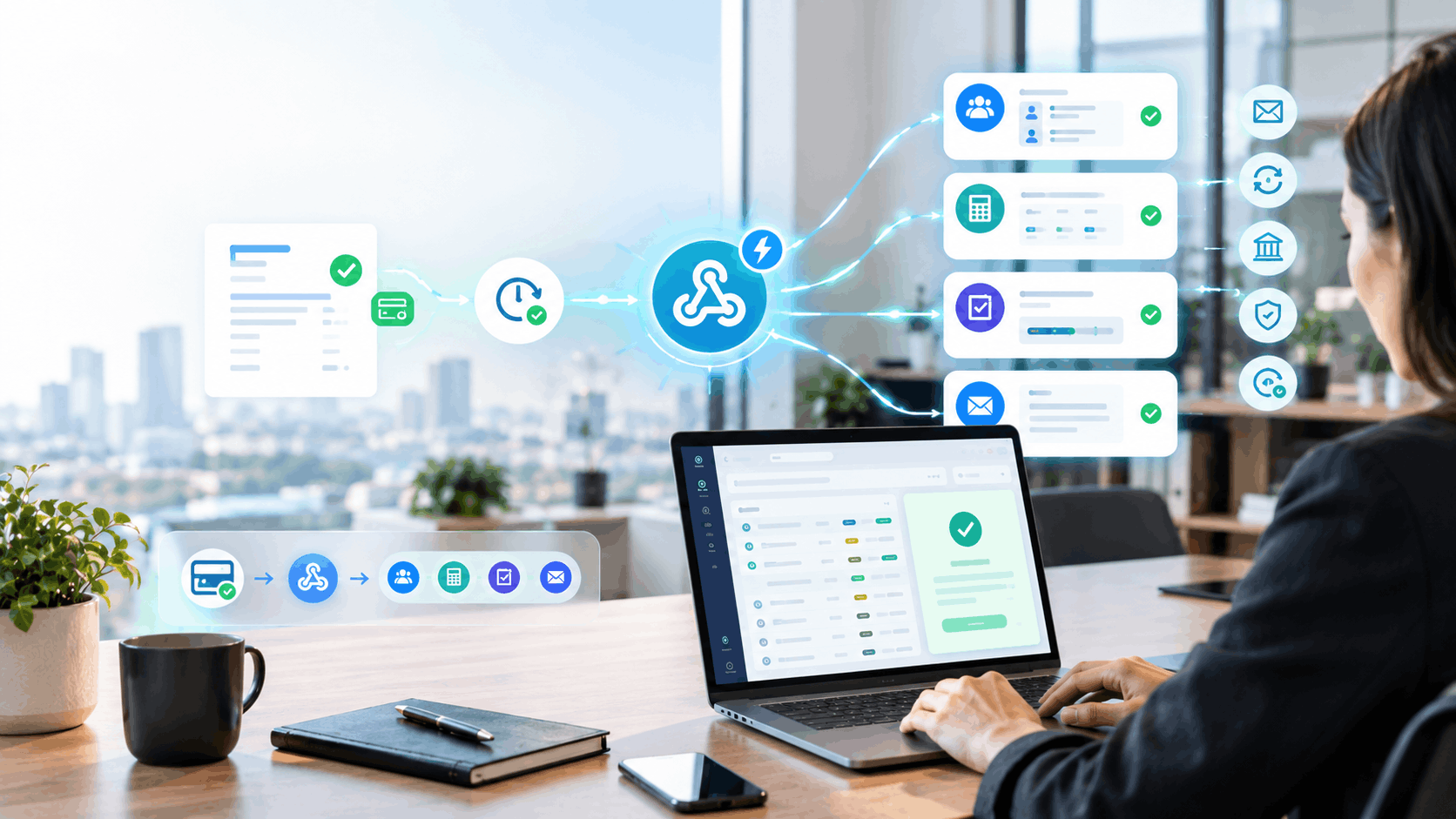
There is a category of billing problem that most agencies live with for years without realising it has a clean solution.
An invoice goes out. A client pays it. Somewhere between payment landing and your team knowing about it, a gap exists. Someone checks the bank account. Someone logs into the invoicing platform. Someone asks the finance team whether a specific client has paid yet. The information exists somewhere in your systems, but it doesn't automatically go where it needs to be, and the delay between payment happening and the right person knowing about it creates friction that multiplies across every client, every invoice, every month.
Webhooks close this gap. They're the mechanism that makes payment events in your billing platform immediately visible to every connected system that needs to know about them, without anyone manually checking or transferring information between tools.
This guide explains what webhooks are, how they work in payment collection specifically, and what they make possible for Australian agencies that want billing automation to actually work in real time rather than in theory.
What a Webhook Is in Plain English
A webhook is a real-time notification that one software system sends to another when a specific event occurs.
The most useful analogy is a push notification on your phone. When someone sends you a message, your phone doesn't periodically check every few minutes to see if any messages have arrived. The messaging platform pushes a notification to your device the moment the message lands. You know about it immediately, without having to go looking.
A webhook works the same way between software systems. When a payment event occurs in your invoicing platform, the platform immediately sends a notification to any connected system that has registered to receive it. The receiving system gets the information instantly and can act on it immediately, without polling for updates or waiting for a manual data transfer.
The contrast with a REST API is useful here. An API is request-based: your system has to ask the invoicing platform for data. "Has this invoice been paid?" Your system asks the question; the platform responds with an answer. Webhooks reverse this: the invoicing platform proactively tells your system what happened, the moment it happened, without your system having to ask.
For payment collection specifically, this distinction is significant. Payment events are time-sensitive. A failed direct debit collection, a payment received on an overdue invoice, a client who clicked a payment link but didn't complete the transaction, a subscription renewal that processed successfully or failed. These are all events that trigger actions in a well-run agency. Webhooks make those actions happen automatically and immediately rather than reactively and manually.
The Payment Events That Matter for Australian Agencies
Not all webhook events are equally valuable. For agencies using a payment collection software in Australia platform for invoicing and direct debit collection, these are the payment events worth configuring webhook notifications for.
Invoice Paid
The most fundamental payment event. When a client pays an invoice through an invoice payment portal or direct debit collection, the paid event should immediately notify every system that needs to know. The CRM updates client payment status. The project management tool marks the billing milestone as complete. The finance team receives a confirmation. All of this happens automatically the moment payment lands, without anyone manually updating records.
Direct Debit Collection Succeeded
For retainer clients on automated direct debit, a successful collection confirmation allows connected systems to update billing status, trigger thank-you communications, and confirm the collection in accounting software without manual intervention.
Direct Debit Collection Failed
This is arguably the highest-value webhook event for agencies using direct debit integration. When a BECS direct debit collection fails due to insufficient funds, account closed, or mandate cancelled, the failing system needs to know immediately. A webhook notification fires the moment the failure is recorded, triggering an automated retry schedule, notifying the account manager responsible for the client relationship, and preventing the failure from sitting undetected until someone manually checks collection results.
Invoice Overdue
When an invoice passes its due date without payment, a webhook notification can trigger an escalation workflow in connected systems. The account manager's CRM task list gets a follow-up item. A finance team alert is generated. The automated reminder sequence is confirmed as active. All of these responses happen automatically rather than waiting for someone to notice the overdue status in the invoicing platform.
Payment Link Clicked But Not Completed
Some invoicing platforms fire a webhook when a client opens a payment link but doesn't complete the transaction. This intent signal is valuable. An account manager who knows a client opened the payment link an hour ago has useful context for a follow-up conversation that an account manager with no payment portal visibility doesn't have.
Subscription Renewed or Cancelled
For agencies with recurring retainer arrangements, subscription lifecycle events are operationally significant. A successful renewal confirmation updates billing forecasts. A cancellation triggers offboarding workflows. Both should happen automatically rather than requiring manual monitoring of subscription status.
How Webhooks Are Configured
Setting up webhooks between your invoicing platform and connected systems requires a small amount of technical configuration, but it's considerably simpler than building a full API integration.
The process works like this. Your receiving system, a CRM or project management tool or custom internal application, provides a webhook endpoint: a URL that is set up to receive incoming notifications. You register this URL in your invoicing platform's webhook settings and specify which events should trigger notifications to that endpoint. From that point, whenever the specified event occurs, the invoicing platform sends a POST request to the registered URL containing the event data in JSON format.
The receiving system processes the incoming data and acts on it. Update the client record. Create a task. Fire an alert. Close a billing milestone. Whatever action the event should trigger in that system happens automatically as soon as the webhook notification arrives.
Most modern invoicing and payment platforms provide a webhook testing interface where you can simulate specific events and verify that your receiving system is handling the notifications correctly before going live. Testing webhook configuration before relying on it for live payment events is essential, given that the value of webhooks depends on the receiving system handling them reliably.
What Webhooks Make Possible That Manual Processes Cannot
The practical value of webhooks becomes clear when you compare what the same payment event looks like with and without them.
Without webhooks, a successful direct debit collection on a retainer invoice means: collection appears in the invoicing platform, where it sits until someone logs in and notices it. That person updates the client record in the CRM, marks the invoice as paid in accounting software, and sends the account manager an update. This sequence takes time, depends on someone remembering to do it, and happens inconsistently.
With webhooks, the same collection triggers automatic notification to every connected system simultaneously. The CRM updates the moment the collection is confirmed. The accounting software marks the invoice as paid. The account manager receives a notification. The billing dashboard shows current status. All of this happens within seconds of the collection being confirmed, without any human involvement.
Multiply this across 30 retainer clients, each generating multiple payment events per billing cycle, and the time saving from webhook automation is substantial. But the more significant benefit is reliability. Webhook-driven updates happen consistently, for every event, every time. Manual updates happen when someone has time and remembers to do them, which means they sometimes don't happen at all.
Security for Webhook Integrations
Webhooks introduce a specific security consideration worth understanding. Because a webhook endpoint is a URL that receives incoming data, it needs to be protected against requests from unauthorised sources. A malicious actor who discovers a webhook endpoint URL could potentially send fake payment notifications that trigger unintended actions in connected systems.
A secure invoicing platform addresses this through webhook signing. Every webhook notification sent by the platform is signed with a secret key known only to the platform and the receiving system. The receiving system verifies the signature before processing any notification. Notifications that don't have a valid signature are rejected, meaning that only genuine notifications from the invoicing platform are acted upon.
HTTPS encryption on the webhook endpoint ensures that the notification data is protected in transit. Combined with signature verification, this makes webhook integrations secure against the most common attack vectors.
Audit logging of webhook delivery is also important. A complete record of which webhooks were sent, when, and whether they were successfully received and processed allows you to identify delivery failures, debug integration issues, and demonstrate to enterprise clients that payment event notifications are handled with appropriate security controls.
Practical Steps for Getting Started With Webhooks
For agencies evaluating their current billing infrastructure or selecting a new platform, here is what to assess and action.
First, identify the payment events that should trigger actions in your connected systems. Map the events to the actions they should produce. Failed direct debit to account manager alert. Invoice paid to CRM update. Subscription cancelled to offboarding task. This mapping exercise often surfaces manual processes that were not previously recognised as automatable.
Second, confirm that your invoicing platform supports webhooks for the specific events you've identified. Not all platforms offer webhooks for all event types. The events that matter most for agency payment collection are direct debit results, invoice payment status changes, and subscription lifecycle events.
Third, assess whether your connected systems have webhook receiving capability built in or whether a developer will need to build a custom endpoint. Many CRMs and project management tools have native webhook support. Custom internal tools will need a developer to build the receiving endpoint and processing logic.
Fourth, configure and test before going live. Use the platform's webhook testing tools to simulate events and verify that connected systems handle the notifications correctly. A webhook integration that fails silently on live payment events is worse than no webhook integration at all.
Frequently Asked Questions
What is a webhook in payment collection?
A webhook is a real-time notification sent by a payment collection platform to a connected system when a specific payment event occurs. Unlike an API where your system requests data, a webhook proactively pushes event data to your system the moment the event happens. In payment collection, webhooks notify connected systems immediately when invoices are paid, direct debit collections succeed or fail, and subscription events occur.
How are webhooks different from APIs in invoicing software?
An API is request-based: your system asks the invoicing platform for data when it needs it. A webhook is event-based: the invoicing platform proactively notifies your system when something happens. Both are useful for billing integrations. APIs handle data retrieval and action initiation. Webhooks handle real-time event notification. Most complete billing automation setups use both.
Are webhooks secure for handling payment data?
Yes, when properly implemented. Secure webhook integrations use signature verification to ensure notifications are genuinely from the invoicing platform, HTTPS encryption to protect data in transit, and audit logging to record all webhook delivery and processing. These controls prevent unauthorised parties from sending fake payment notifications and ensure that all webhook activity is traceable for security and compliance purposes.
Do I need a developer to set up webhooks for my agency?
For simple webhook integrations with common tools like CRMs or project management platforms that have built-in webhook support, limited development work is needed. For custom webhook endpoints that feed internal systems or trigger complex workflows, a developer is required to build the receiving endpoint and processing logic. The invoicing platform's webhook documentation and testing tools make the development work more straightforward than building a full API integration from scratch.