There is a specific point in every growing agency's journey where sending invoice emails manually stops being a minor inconvenience and starts being a genuine operational problem.
At ten clients it is manageable. At twenty it is time-consuming. At thirty it is taking someone's entire morning. And at forty or fifty active clients billing on different schedules, different amounts, and different terms, manual invoice email delivery has become a bottleneck that directly limits how quickly the agency can grow without proportionally increasing admin headcount.
The solution is not working faster or hiring a dedicated billing person. The solution is automated invoice email delivery at scale, built on infrastructure that handles volume, deliverability, and professional presentation without human involvement in the routine cases.
This guide covers exactly how to build this capability, what infrastructure it requires, and what the difference looks like between agencies that have done it and those that haven't.
Why Manual Invoice Email Delivery Breaks at Scale
Manual invoice email delivery has three failure modes that become increasingly damaging as client volume grows.
The first is time cost. Creating each invoice, attaching it, addressing the email, writing a covering message, and sending it individually takes 5 to 8 minutes per invoice in a well-organised workflow. At 40 clients, that is 3 to 5 hours of someone's time every billing cycle, before any follow-up or exception handling is added.
The second is inconsistency. Manual processes produce variable outcomes. Invoices go out on different days. Covering messages have different tones. Some emails include payment instructions clearly; others don't. Some clients receive invoices promptly; others wait longer because the person responsible was busy on that particular day. Inconsistency in invoice delivery creates inconsistency in payment timing, which creates cash flow variability that compounds month over month.
The third is deliverability. Personal email accounts and standard business email systems are not optimised for transactional email delivery at volume. Invoices sent from Gmail or Outlook at scale increasingly end up in spam folders, promotions tabs, or filtered by enterprise clients' email security systems. A client whose invoice is in their spam folder doesn't know they have an invoice to pay, which means the payment delay starts at delivery failure rather than at client action.
Automated invoice email delivery through a dedicated transactional email infrastructure eliminates all three failure modes simultaneously.
The Infrastructure Behind Automated Invoice Email at Scale
Automated invoice email delivery is not simply scheduling an email send from a regular email client. It requires three layers of infrastructure working together.
A smart invoicing software platform that generates invoice content automatically from client records and billing schedules, applies the correct template, includes embedded payment links, and triggers delivery through a connected transactional email service. The invoicing platform is the source of truth for what gets sent to whom and when.
A transactional email service optimised for high-volume, time-sensitive automated email delivery. Transactional email services maintain dedicated IP addresses with established sender reputations, implement authentication standards (SPF, DKIM, and DMARC) that improve inbox placement, provide delivery confirmation and open tracking at the individual email level, and handle bounce processing and list hygiene automatically. This is the infrastructure that makes the difference between an invoice email that reaches the client's inbox and one that ends up in their spam folder.
A business payment platform that connects invoice delivery to payment collection, so that each invoice email contains an embedded payment link that takes the client directly to a secure payment interface rather than requiring manual bank transfer initiation. The payment link is what converts invoice delivery from a notification into a collection mechanism.
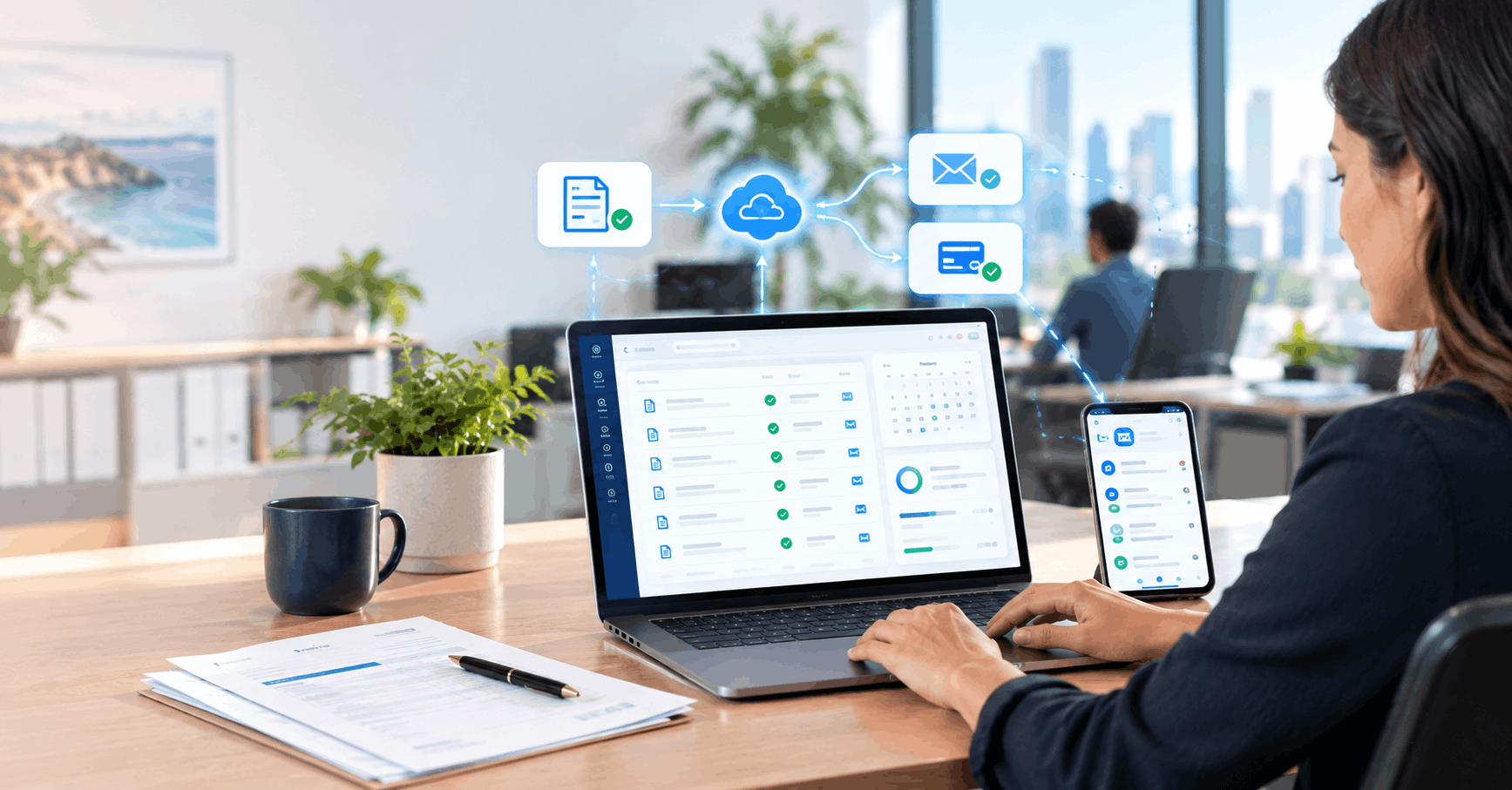
When these three layers are connected, the invoice email workflow becomes: billing schedule triggers invoice generation, invoicing platform creates the invoice from the client template, transactional email service delivers it with authenticated headers and delivery tracking, client clicks the embedded payment link, payment is collected automatically. The only human involvement is in the initial configuration and in handling genuine exceptions.
Deliverability: The Technical Detail That Determines Whether Emails Arrive
Deliverability is the dimension of automated invoice email that most agencies underestimate until they discover that clients aren't receiving invoices that the system shows as sent.
Email deliverability is determined by a combination of technical authentication, sender reputation, and content quality. Understanding each one helps you configure automated invoice email correctly from the start.
SPF (Sender Policy Framework) is a DNS record that specifies which mail servers are authorised to send email on behalf of your domain. When a transactional email service sends invoice emails on your behalf, your SPF record needs to authorise that service's mail servers. An invoice email sent from a service not included in your SPF record is likely to be rejected or marked as spam by the recipient's mail server.
DKIM (DomainKeys Identified Mail) adds a cryptographic signature to each email that verifies the email was sent by an authorised sender and has not been modified in transit. Most transactional email services provide a DKIM key that needs to be added to your domain's DNS records. Without DKIM, emails are more likely to be flagged as suspicious by enterprise email security systems.
DMARC (Domain-based Message Authentication, Reporting, and Conformance) builds on SPF and DKIM to specify what should happen to emails that fail authentication checks and provides reporting on authentication failures. A DMARC policy on your domain signals to receiving mail servers that your domain takes email security seriously, which improves sender reputation for legitimate emails.
For agencies sending invoice emails to enterprise clients whose email security systems are aggressive about filtering, getting SPF, DKIM, and DMARC correctly configured is not optional. It is the difference between invoices arriving and invoices disappearing without the client knowing they were sent.
Building Automated Invoice Email for Different Billing Types
Not all invoice emails are the same, and a well-configured automated system handles different billing types with appropriate delivery logic for each.
Recurring retainer invoices should be generated and delivered automatically on the configured billing date without any manual initiation. The client record, billing amount, and delivery schedule are configured once; delivery happens automatically every cycle. For retainer clients also on direct debit, the invoice email serves as a pre-collection notification rather than a payment request, giving the client advance notice that the collection is coming.
Project milestone invoices are triggered by milestone completion rather than calendar date. This requires either a manual send trigger from the project manager when the milestone is marked complete, or an automated trigger through an integration between the project management tool and the invoicing platform. The invoicing API for developers enables this second approach, allowing the project management system to call the invoicing API when a milestone is approved and automatically trigger invoice generation and delivery without human involvement.
Ad-hoc invoices for variable or one-off work still benefit from automated delivery infrastructure even when creation is manual. An invoice created manually in the invoicing platform is still delivered through the transactional email service with authenticated headers, tracked delivery, and an embedded payment link. The creation step involves human action; the delivery and follow-up infrastructure handles the rest automatically.
Personalisation at Scale Without Manual Effort
One concern agencies have about automated invoice email is that it will feel impersonal to clients who are used to receiving individually written billing communications. This concern is legitimate but addressable through template personalisation rather than manual email writing.
Effective invoice email templates use dynamic fields that pull from client records to personalise each email automatically. The client's name, business name, invoice amount, due date, specific services delivered, and account manager name can all be personalised fields that populate from the invoicing platform's data without manual input for each send.
The result is an invoice email that reads as personally addressed even though it was generated automatically. The client sees their name, their invoice details, and relevant context rather than a generic template with obvious placeholders. Done well, automated personalisation produces more consistent personalisation than manual emails, where the degree of personalisation depends on who wrote the email and how much time they had.
Security for Automated Invoice Email
Automated invoice email at scale introduces a security dimension worth addressing directly. Invoice emails are targeted by fraudsters who intercept them to substitute payment details, and high-volume automated sends from a recognisable domain are a more valuable interception target than individual manual sends.
Enterprise payment security software addresses this through the structure of the payment mechanism rather than the email itself. When invoice emails contain embedded payment links that direct clients to a secure, platform-hosted payment interface rather than to bank account details in the email body or an attachment, there are no payment credentials to intercept and substitute. The payment link points to an authenticated platform environment that cannot be modified between sender and recipient.
Combined with SPF, DKIM, and DMARC authentication that makes spoofing your domain significantly harder, this structural approach to invoice email security protects both your business and your clients from the payment redirection fraud that targets invoice communications specifically.
Frequently Asked Questions
What is automated invoice email delivery?
Automated invoice email delivery is the process of generating and sending invoice emails to clients automatically, without manual creation or sending for each invoice. It combines invoicing software that generates invoice content from client records and billing schedules with transactional email infrastructure that delivers emails reliably at scale with authenticated headers and delivery tracking.
Why do automated invoice emails sometimes end up in spam?
Automated invoice emails end up in spam when the sending infrastructure lacks proper email authentication. SPF, DKIM, and DMARC records need to be correctly configured for your domain and the transactional email service sending on your behalf. Without these authentication standards, receiving mail servers treat automated emails as suspicious and route them to spam folders regardless of content quality.
Can automated invoice emails be personalised for each client?
Yes. Effective invoice email templates use dynamic fields that pull client-specific data from the invoicing platform automatically. Client name, business name, invoice amount, due date, and service descriptions can all be personalised fields that populate without manual input. The result is personalised email content generated automatically for every client at any scale.
How does an invoicing API help with automated email delivery?
An invoicing API allows external systems to trigger invoice generation and delivery programmatically. A project management tool that marks a milestone as complete can call the invoicing API to automatically generate and deliver the corresponding milestone invoice without any manual step. This extends automated delivery to invoices triggered by external events rather than only those on fixed billing schedules.