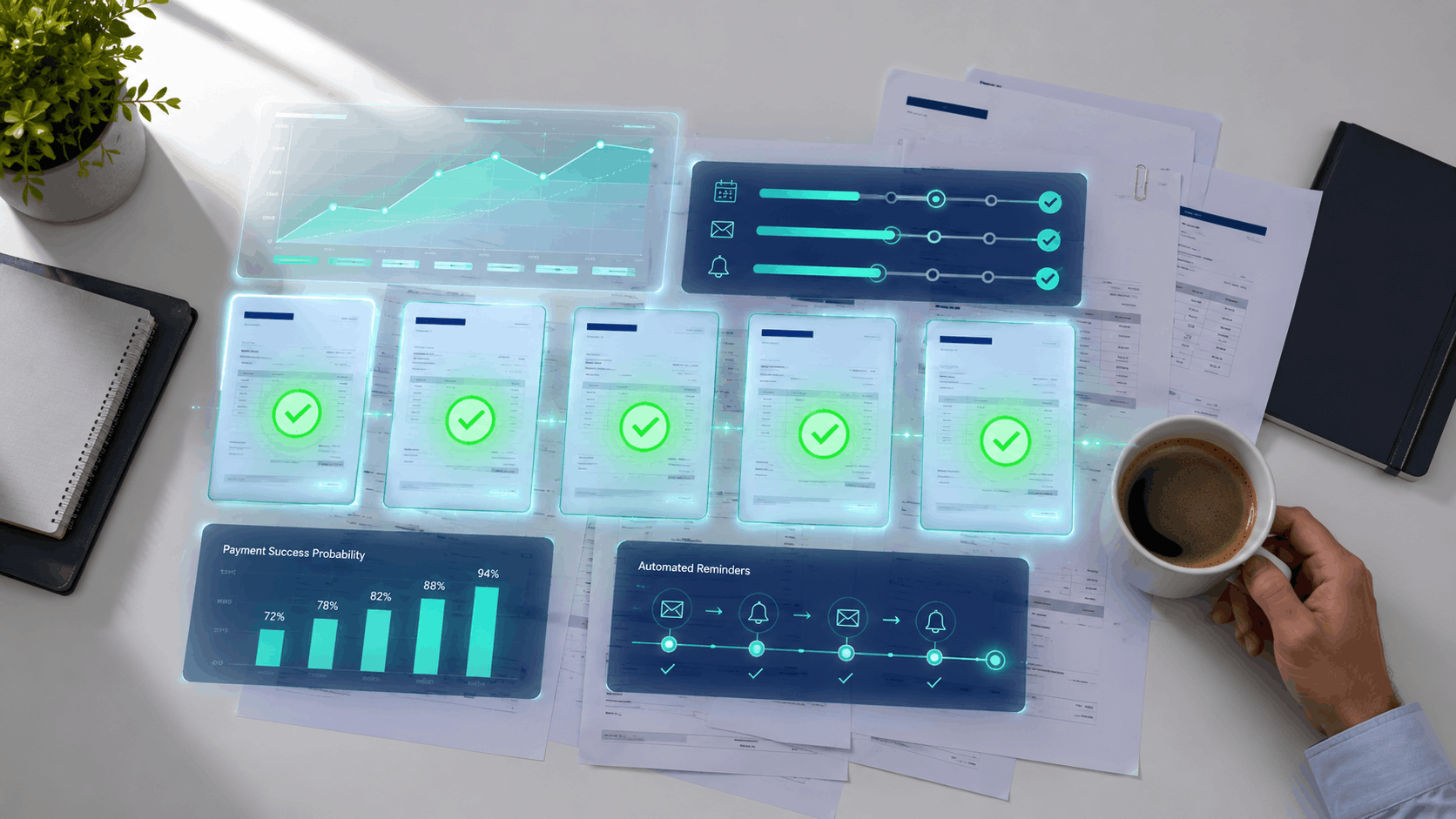
Three years ago, AI invoice automation was something large enterprise finance teams discussed in strategy sessions and rarely implemented. Today it's something a 10-person Australian agency can set up in an afternoon — and the gap between businesses that have automated their invoicing and those that haven't is becoming measurable in cash flow, admin hours, and client payment speed.
The shift has happened faster than most business owners expected. Not because the technology changed dramatically overnight, but because the infrastructure required to deploy it — the AI models, the payment rails, the integration layers — became accessible at a price point and complexity level that smaller businesses could actually work with.
This post explains exactly how AI invoice automation works, what it automates and what it doesn't, why Australian businesses specifically are adopting it faster than many comparable markets, and what the practical implementation looks like for an agency or service business that hasn't automated yet.
What AI Invoice Automation Actually Is
The term "AI invoice automation" gets used loosely enough that it's worth being precise about what it means in practice — because there's a meaningful difference between basic invoicing software that does scheduled sends and genuine AI-powered automation that learns, adapts, and makes decisions.
At the basic end, invoice automation means scheduled, rule-based tasks: generate an invoice on this date, send it to this email address, follow up if unpaid after this many days. This kind of automation has been available for years and is valuable — but it's not AI in any meaningful sense. It's scripted behaviour.
At the AI end, invoice automation means the system is doing something more sophisticated: analysing payment behaviour patterns to predict which invoices are at risk of going overdue before they do, adjusting follow-up timing and tone based on individual client response history, optimising collection sequences based on what has worked for similar clients, and making real-time decisions about when to escalate, when to retry, and when to flag for human review.
The practical distinction matters because it determines what the system can handle without human oversight. A rule-based system follows its rules regardless of context. An AI-powered system adjusts its behaviour based on what it's learned — which means it handles edge cases better, produces fewer false positives in escalation logic, and gets more effective over time as it accumulates more payment behaviour data.
For Australian businesses, the most immediately valuable AI capabilities in invoice automation are predictive overdue detection, intelligent follow-up sequencing, and automated retry optimisation for failed direct debit and card collections.
How AI Invoice Automation Works: The Technical Stack
Understanding how AI invoice automation works helps businesses evaluate platforms more effectively and set realistic expectations about what automation can and can't do.
Invoice Generation Layer
The invoice generation layer is where automation begins. AI-powered invoice generation goes beyond scheduled template sends in two important ways.
First, it can extract billing data from connected systems — time tracking tools, project management platforms, CRM records — and populate invoice line items automatically without manual data entry. An invoice for a retainer client with variable monthly scope inclusions can be generated from actual delivered work records rather than from a manually assembled summary.
Second, AI invoice generation can flag anomalies before invoices are sent — line items that differ significantly from historical invoices for the same client, GST calculations that don't match expected amounts, billing contacts that have changed since the last invoice. These flags surface for human review rather than sending incorrect invoices that create client friction.
Delivery and Timing Intelligence
Basic automation sends invoices at a scheduled time. AI-powered delivery optimises send timing based on when individual clients are most likely to open and action an invoice.
If a client's payment history shows they consistently review and pay invoices on Tuesday mornings, the system delivers the invoice on Tuesday morning rather than on the 1st of the month at midnight when nobody is looking at their inbox. This kind of delivery timing optimisation — applied across a full client base — meaningfully improves same-day payment rates without any additional follow-up required.
Predictive Overdue Detection
This is one of the highest-value AI capabilities in invoice automation. Rather than waiting for an invoice to become overdue before triggering a reminder sequence, predictive models identify invoices at elevated risk of late payment before the due date and adjust the follow-up approach accordingly.
The signals a predictive model uses include: the client's historical payment timing patterns, how long since the invoice was opened, whether the payment link has been clicked, the current invoice amount relative to the client's typical invoice size, and seasonal patterns in the client's payment behaviour (some clients consistently pay late in December regardless of invoice timing, for example).
An invoice flagged as high overdue risk by the predictive model might receive an earlier pre-due reminder, a more direct message tone, or a proactive reach-out from the account manager — before the invoice is overdue, rather than after.
Intelligent Follow-Up Sequencing
Standard automation sends the same reminder template at the same intervals for every overdue invoice. AI-powered sequencing personalises both the timing and the content of follow-up communications based on client history and invoice context.
A client who has always paid within 48 hours of the first reminder gets a different first message — and a longer wait before the second — than a client who has required three reminders on every previous invoice. A client who opened the payment link but didn't complete payment gets a different message than one who hasn't opened the invoice at all.
This personalisation isn't just about tone — it's about sequence efficiency. An AI system that sends the right message at the right time to the right client collects the same invoice with fewer touchpoints on average, which means less friction in the client relationship and less noise in the account manager's inbox.
Payment Retry Optimisation
For businesses using direct debit or recurring card billing, failed payment retry logic is where AI automation produces some of its most concrete value.
Standard retry logic retries failed collections at fixed intervals — day 3, day 6, day 9 after failure. AI retry optimisation analyses the failure reason, the client's bank account patterns, and historical data on when retries for similar failure types succeed, and schedules retries at the times most likely to produce a successful collection.
A failure due to insufficient funds on the 28th of the month, for example, is more likely to succeed on the 2nd of the following month — after the client's own payroll or revenue has cleared — than on day 3 after the initial failure. An AI retry system makes this inference automatically and schedules accordingly.
Reconciliation and Anomaly Detection
AI-powered reconciliation goes beyond matching payments to invoices — it flags patterns that suggest problems worth investigating. Duplicate payments. Partial payments without a corresponding credit note. Payments received from unexpected accounts. Clients who have started paying significantly later than their historical pattern without any change in invoice terms.
These anomaly flags surface for human review rather than requiring someone to manually scan transaction data looking for irregularities — a task that rarely happens consistently in manually managed billing workflows.
Why Australian Businesses Are Adopting AI Invoice Automation Faster
Australia has some specific market characteristics that make AI invoice automation particularly valuable compared to comparable international markets.
The Late Payment Problem Is Acute in Australia
Australian small and medium businesses have a chronic late payment problem that's well-documented by research from Xero, MYOB, and the Australian Small Business and Family Enterprise Ombudsman. Average invoice payment times in Australia consistently run 7–14 days beyond stated terms across the SME sector — meaning a 14-day invoice is being paid at 21–28 days on average.
The aggregate cost of this late payment culture is significant — billions of dollars in working capital locked in overdue invoices across the economy at any given time. AI invoice automation directly attacks this problem through predictive detection and intelligent follow-up, which is why the value proposition resonates particularly strongly with Australian business owners who have lived with late payment as a structural feature of their operating environment.
BECS Direct Debit Creates a Uniquely Automatable Collection Mechanism
Australia's BECS direct debit rail — the bank-to-bank payment system used for most recurring B2B payment collection — is one of the most stable and automatable payment infrastructure layers available anywhere. Unlike markets where recurring payment collection requires card-based systems with expiry and fraud exposure, BECS provides a low-failure, high-reliability collection mechanism that AI automation can build on with confidence.
The combination of AI-powered collection intelligence and BECS infrastructure — accessible through an invoice payment solution that supports both — produces better automated collection outcomes in Australia than the same AI logic running on less stable payment rails in other markets.
Australian Privacy Act Creates Compliance Pressure That Favours Automation
The Australian Privacy Act's notifiable data breach provisions create real compliance pressure for any business handling client financial data manually. Manual invoicing workflows — PDF attachments, bank details in emails, payment data in spreadsheets — create compliance exposure that purpose-built AI invoice automation platforms address structurally through data encryption invoicing software with AES-256 encryption at rest, TLS 1.2+ in transit, and certified payment processor tokenisation.
As Privacy Act enforcement has become more active, the compliance case for AI invoice automation has strengthened alongside the operational case — which accelerates adoption among businesses that might otherwise defer the investment.
The Accounting Software Ecosystem Supports Integration
Australia has unusually high adoption of cloud accounting software — Xero in particular has market penetration among Australian SMEs that significantly exceeds most comparable markets. This matters for AI invoice automation because the value of automation increases with the depth of integration into connected systems.
An AI invoice automation platform that integrates with Xero through direct payroll integrations can pull billing data, sync payment status, and maintain accurate books automatically — creating a fully connected financial workflow rather than a billing tool that operates in isolation. The existing Xero infrastructure in most Australian businesses makes this integration immediately valuable rather than requiring new system adoption.
What AI Invoice Automation Specifically Handles
To set accurate expectations, here's a clear breakdown of what AI invoice automation handles and what still requires human involvement.
Fully automated (no human involvement required)
Invoice generation for recurring clients — invoices created from billing schedules and client records automatically on the configured date.
Invoice delivery and timing optimisation — delivery scheduled for optimal open rates based on individual client behaviour patterns.
Pre-due reminders — sent automatically at configured intervals before the due date, with timing and content adjusted per client history.
Overdue follow-up sequences — escalating reminders sent automatically at configured post-due intervals, personalised per client.
Direct debit collection — payment pulled from client bank accounts on the due date without client or agency action required.
Failed payment retry — retries scheduled automatically at AI-optimised timing based on failure reason and client patterns.
Payment reconciliation — invoice status updated automatically when payment is received, syncing to connected accounting software.
Anomaly flagging — unusual payment patterns surfaced for review without manual transaction monitoring.
Requires human involvement
New client onboarding — scoping, pricing, and agreement terms require human negotiation regardless of how automated subsequent billing is.
Dispute resolution — clients who dispute invoice accuracy or scope require a human conversation. AI automation can flag the dispute and pause the reminder sequence; it can't resolve the underlying issue.
Persistent non-payment escalation — when automated retry and reminder sequences are exhausted without payment, escalation to collections or legal action requires human decision-making.
Scope change billing adjustments — when a retainer scope changes, the billing schedule needs to be updated by a human who is aware of the change. Automation doesn't know about conversations that happened outside the billing platform.
Relationship-sensitive situations — a long-term client going through a difficult period, a payment dispute that has relationship implications, a client requesting an informal payment arrangement — these require human judgment that AI automation isn't designed to replace.
The Implementation Reality: What It Takes to Get Started
The gap between "evaluating AI invoice automation" and "running AI invoice automation" is smaller than most businesses expect — particularly for agencies that are already using some form of invoicing software.
Week 1: Platform configuration Set up the invoicing platform, configure client records and billing schedules, build invoice templates, connect payment methods. For a 20–30 client agency, this typically takes 1–2 days of focused setup time.
Week 1–2: AI feature configuration Configure the predictive follow-up logic — set the overdue risk thresholds, customise the reminder sequence content and timing, define escalation rules for persistent non-payment. Most platforms provide sensible defaults that work without significant customisation; adjusting them for your specific client base and billing culture is a refinement rather than a foundational step.
Week 2: Integration connections Connect the platform to your accounting software for automatic reconciliation. Connect payment processing for direct debit and card collection. Connect communication channels for automated delivery and reminders. The specific integrations available depend on your platform — look for ones that support BECS direct debit, Xero or QuickBooks sync, and webhook-based event notifications as a minimum.
Week 2–3: Direct debit mandate collection For retainer clients, collect direct debit mandates to enable automated collection. Send mandates digitally through the platform, follow up on any outstanding signatures, and configure collection schedules once mandates are in place.
Week 3 onwards: Monitor and refine Review the first automated billing cycle — delivery rates, payment timing, reminder performance, reconciliation accuracy. Adjust configuration based on what you observe. AI systems improve with data, so the second month typically performs better than the first, and performance continues to improve as the system accumulates client behaviour history.
The Metrics That Show Whether It's Working
AI invoice automation produces measurable outcomes that are trackable from the first month of implementation. Here are the metrics worth monitoring.
Average days to payment — the number of days between invoice send and payment received. A well-configured AI automation system should reduce this by 20–40% within the first two billing cycles for most agencies.
Overdue rate — the percentage of invoices that exceed their payment due date. This is the most direct measure of automation effectiveness and should decline meaningfully as the predictive follow-up logic builds client behaviour history.
Collection success rate on first direct debit attempt — for businesses using direct debit, this measures how effectively the system is timing collections to match client fund availability. First-attempt success rates above 95% indicate well-optimised retry logic.
Admin time on billing — total hours per month spent on invoicing-related tasks. This should decline sharply in the first month and continue declining as the system handles more of the routine workflow automatically.
MRR collected on schedule — for businesses tracking MRR, the percentage of recurring revenue collected within 3 days of the due date is a cash flow health metric that AI automation directly improves.
What to Look For in an AI Invoice Automation Platform
Not all platforms that claim AI invoice automation capabilities deliver the same depth of intelligence. Here's what to look for when evaluating options.
Genuine predictive logic vs rule-based scheduling — ask specifically whether the follow-up timing is fixed by rules or adaptive based on client behaviour data. The answer tells you whether you're getting actual AI or scheduled automation marketed as AI.
BECS direct debit support — for Australian businesses, this is non-negotiable. Any platform that doesn't support Australian bank account direct debit is missing the highest-reliability collection mechanism available.
Integration depth — accounting software sync (Xero, QuickBooks), webhook support for real-time event notifications, REST API access for custom workflow integration. Shallow integrations create manual handoff points that undermine automation value.
Security infrastructure — payment data should be handled by certified processors under PCI DSS-aligned infrastructure, with all data encrypted at rest and in transit and full audit logging of every billing action.
Transparency of AI decisions — can you see why the system made a specific decision? Good AI automation platforms show you the logic behind follow-up timing and retry scheduling rather than operating as a black box. Transparency lets you refine configuration and build confidence that the system is operating as intended.
Australian market fit — tax invoice compliance with ATO requirements, GST handling, AUD support, and BECS integration are all market-specific requirements that international platforms sometimes handle poorly. A platform built for or specifically configured for the Australian market handles these as defaults.
Frequently Asked Questions
What is AI invoice automation?
AI invoice automation uses artificial intelligence to handle the invoicing and payment collection lifecycle — generating invoices automatically, optimising delivery timing based on client behaviour, predicting which invoices are at risk of going overdue, personalising follow-up sequences per client history, and optimising payment retry timing for failed collections. It goes beyond basic scheduled automation by adapting its behaviour based on data rather than following fixed rules.
How is AI invoice automation different from standard invoicing software?
Standard invoicing software automates scheduled tasks — send an invoice on this date, send a reminder after this many days. AI invoice automation adapts its behaviour based on client payment history, predicts overdue risk before invoices become late, personalises follow-up timing and content per client, and optimises retry logic for failed payments. The difference is between scripted behaviour and adaptive intelligence.
Is AI invoice automation suitable for small Australian agencies?
Yes — modern AI invoice automation platforms are accessible to businesses of all sizes. A 5–10 person agency with 15–25 active clients benefits from AI automation in proportion to the time currently spent on manual invoicing admin. The platforms available today don't require enterprise budgets or technical implementation teams — most agencies are fully configured and running automated billing within a week.
What Australian payment methods does AI invoice automation support?
The most effective AI invoice automation platforms for Australian businesses support BECS direct debit for bank account collection, card payments via payment links, and bank transfer with automated reconciliation. BECS direct debit is the highest-value collection mechanism for recurring billing because it allows AI-optimised collection timing without requiring client action.
How secure is AI invoice automation for handling client payment data?
A properly configured AI invoice automation platform handles payment data through certified payment processors under PCI DSS-aligned infrastructure. Card and bank account details are tokenised and never stored on the invoicing platform's servers. All data is encrypted in transit using TLS 1.2+ and at rest using AES-256. Audit logging records every billing action with timestamps and user IDs. This is substantially more secure than manual invoicing workflows where payment data moves through unencrypted email attachments.
How long does it take to see results from AI invoice automation?
Most businesses see measurable improvement in average payment times and overdue rates within the first complete billing cycle after implementation — typically 30–45 days from setup. The predictive and personalisation capabilities of AI automation improve further as the system builds client behaviour history over subsequent months, so month three typically outperforms month one even with identical configuration.
Will AI invoice automation replace my accounts receivable team?
No — AI invoice automation handles the routine, repetitive components of accounts receivable that currently consume the most time: invoice generation, delivery, reminders, collection, and reconciliation. Human involvement remains essential for dispute resolution, relationship-sensitive situations, escalation decisions, and scope or billing structure changes. The practical outcome is that your accounts receivable function can handle significantly more billing volume without additional headcount — not that headcount becomes unnecessary.