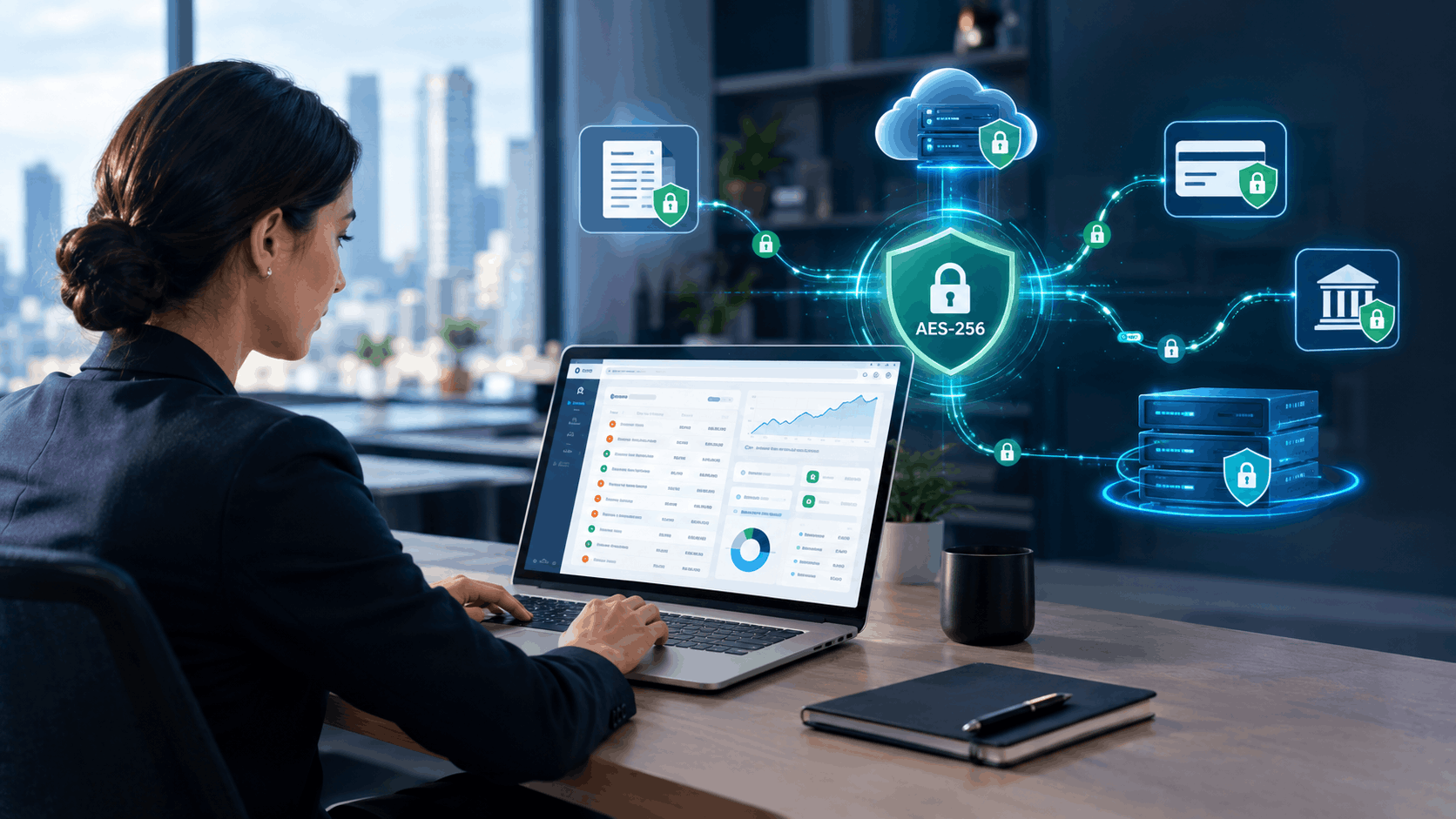
When a payment platform says your data is protected by AES-256 encryption, most business owners nod and move on. The term sounds reassuringly technical. It clearly involves numbers. It probably means something important.
But "probably means something important" is not the same as understanding what it means — and for Australian businesses handling client payment data, bank account details, and invoice records, understanding what AES-256 actually does and why it matters is more than a technical curiosity. It's the difference between knowing your billing infrastructure is secure and simply hoping it is.
This post explains AES-256 encryption in plain English — what it is, how it works, why it's the standard for payment data protection, and what it means in practice for your invoicing software and the client data flowing through it.
What AES-256 Actually Is
AES stands for Advanced Encryption Standard. It's a symmetric encryption algorithm — meaning the same key is used to both encrypt and decrypt data — that was established as the US government's encryption standard in 2001 and has since become the global default for protecting sensitive data at rest.
The 256 refers to the key length — 256 bits. This is the length of the cryptographic key used to encrypt and decrypt the data. A longer key means more possible key combinations, which means more computational effort required to break the encryption by trying every possible key — a brute-force attack.
To put the key length in context: AES-256 has 2²⁵⁶ possible key combinations. That's a number with 78 digits. The fastest computers currently available, working in parallel for the entire estimated age of the universe, could not test all possible AES-256 keys. This is why AES-256 is described as computationally unbreakable with current technology — not because it's theoretically impossible to crack, but because it would require resources and time that don't exist.
AES-256 is the encryption standard used by the US National Security Agency for top secret information, by financial institutions globally for transaction data, by cloud providers for stored data, and by purpose-built data encryption invoicing software for client payment records. When something this sensitive chooses AES-256, the underlying reason is the same: it provides a security level that, with current technology, is not practically breakable.
Encryption at Rest vs Encryption in Transit
Understanding AES-256 requires understanding a distinction that most business owners have heard but rarely have explained clearly: the difference between encryption at rest and encryption in transit.
Encryption at rest means data is encrypted when it's stored — on a server, in a database, on a hard drive. If an attacker gains access to the storage system — through a breach, a misconfigured database, or physical access to hardware — encrypted data at rest is unreadable without the decryption key. AES-256 is the standard algorithm used for encryption at rest.
Encryption in transit means data is encrypted while it's moving — between your browser and a server, between two systems communicating via API, between your device and a payment processor. TLS (Transport Layer Security), currently at version 1.2 and 1.3, is the standard protocol for encryption in transit. When you see "https" in a URL, TLS is what's providing the encryption for that connection.
Both matter for smart invoicing software. A platform that encrypts data in transit but not at rest leaves stored payment records vulnerable to a database breach. A platform that encrypts at rest but not in transit leaves payment data exposed during transmission. Genuine payment data security requires both — and any invoicing platform worth using should implement both as defaults, not as optional configurations.
Why AES-256 Specifically — Not AES-128
AES comes in three key lengths: 128, 192, and 256 bits. AES-128 is also considered secure by current cryptographic standards — there's no known practical attack against it. So why does AES-256 matter specifically?
Two reasons.
First, margin of safety. Cryptographic standards are broken by advances in computing power and mathematical research — gradually, then suddenly. AES-128, while currently secure, has half the key length of AES-256 and would be the first to become vulnerable if advances in quantum computing or cryptanalysis reduce the effective security of AES. AES-256 provides a larger security margin against future threats — which matters when the data being protected (client payment records, banking details) may be sensitive for years or decades.
Second, regulatory and contractual requirements. PCI DSS and many enterprise security frameworks specify AES-256 as the minimum standard for protecting cardholder data at rest. Invoicing platforms handling payment data that use AES-128 rather than AES-256 may not meet the requirements of enterprise client security questionnaires — an increasingly common obstacle in agency and service business sales processes.
How AES-256 Fits Into Your Invoicing Software's Security Architecture
AES-256 encryption is not a standalone security measure — it's one component of a layered security architecture. Understanding how it fits alongside other controls explains why choosing the right invoicing platform matters more than the encryption algorithm alone.
Tokenisation works alongside AES-256 for payment credential protection. When a client enters card or bank account details through a payment link or invoice payment portal, tokenisation replaces the sensitive credentials with a non-sensitive token before they reach your systems. Your invoicing platform stores the token; the actual payment credentials never leave the certified payment processor's environment. AES-256 encrypts the records in your platform; tokenisation means those records don't contain the original credentials even in their encrypted form.
Payment platform integrations in Australia that connect your invoicing software to certified payment processors through encrypted API connections extend the AES-256 security model across the integration layer. Data moving between your invoicing platform and connected systems — accounting software, CRM, payment processors — should travel through TLS 1.3-encrypted connections, with the data itself protected by AES-256 at every storage point along the path.
Role-based access controls determine who can access the decryption keys or the systems that handle decryption. AES-256 encryption protects data from external attackers who gain access to storage systems without authorisation. It doesn't protect against authorised users who have access to systems that perform decryption. Access controls — limiting who can access which data and under what conditions — are the complementary control that protects against internal exposure.
Audit logging records who accessed what data and when. Even with encryption, access logging is essential for detecting unusual data access patterns that might indicate an insider threat or a compromised credential. Complete security architecture requires both strong encryption and complete visibility into how that encrypted data is being accessed.
What AES-256 Means for Your Clients
The practical significance of AES-256 encryption in your invoicing software is most clearly understood from your clients' perspective — particularly enterprise clients who ask about data security as part of supplier onboarding.
When a client's finance or IT team asks how their payment data is protected, "we use AES-256 encryption at rest and TLS 1.2+ in transit" is a specific, verifiable answer that maps directly to standards they recognise. It's meaningfully different from "we use bank-grade security" — a marketing phrase that conveys nothing verifiable.
For agencies and service businesses competing for enterprise accounts, the ability to answer security questionnaires with specific technical standards rather than general assurances is a competitive advantage that compounds over time. Enterprise procurement teams who receive clear, standard-aligned answers complete their security assessments faster and with more confidence — which accelerates the sales process and reduces the likelihood of security concerns killing a deal at a late stage.
For smaller clients who don't ask technical security questions, the significance of AES-256 is about what it prevents — the scenario where a data breach affecting your billing systems exposes client payment data in a form that can be used fraudulently. Encrypted data that is breached is not the same as unencrypted data that is breached. The former is a security incident; the latter is a financial harm event for every client whose data was exposed.
Evaluating Invoicing Software for Encryption Standards
When evaluating invoicing software for payment data security, these are the encryption-specific questions worth asking:
Is data encrypted at rest, and with what algorithm? AES-256 is the standard to look for. AES-128 is acceptable; anything below that warrants further investigation.
Is data encrypted in transit, and with what protocol? TLS 1.2 is the minimum current standard; TLS 1.3 is preferable. Older protocols (TLS 1.0, TLS 1.1, SSL) have known vulnerabilities and should not be in use.
Are encryption keys managed separately from encrypted data? Storing encryption keys alongside encrypted data undermines the security value of encryption — if an attacker gains access to the data store, they also gain the keys. Key management should be handled through a separate, purpose-built system.
Does the platform use tokenisation for payment credentials? Tokenisation means that even if your invoicing platform's encrypted database is compromised, it doesn't contain the raw payment credentials — only tokens that reference credentials stored in the certified processor's environment.
Can the platform demonstrate its security controls? Published security documentation, third-party penetration testing, and SOC 2 compliance reports are the mechanisms through which a platform demonstrates that its stated encryption standards are actually implemented and operating as described.
Frequently Asked Questions
What is AES-256 encryption in simple terms?
AES-256 is a method of scrambling data using a 256-bit key so that it becomes unreadable without the correct decryption key. It's the encryption standard used by governments, financial institutions, and payment platforms globally for protecting sensitive data because it provides a security level that is not practically breakable with current computing technology.
Does my invoicing software need AES-256 encryption?
If your invoicing software handles client payment data — card details, bank account information, or payment records associated with identified individuals — AES-256 encryption at rest is the appropriate standard. It's required by PCI DSS for cardholder data storage and expected by enterprise clients in supplier security assessments. Platforms that don't specify their encryption standard, or that use lower standards, represent a higher security risk for payment data.
What is the difference between AES-256 and TLS encryption?
AES-256 is used for encrypting data at rest — data stored in databases and on servers. TLS (Transport Layer Security) is used for encrypting data in transit — data moving between systems over a network. Both are necessary for comprehensive payment data security. Most invoicing platforms that implement AES-256 at rest also implement TLS 1.2+ in transit — the two controls address different parts of the data lifecycle.
Is AES-256 encryption enough to protect client payment data?
AES-256 is an essential component of payment data security but not sufficient on its own. Complete protection requires AES-256 encryption at rest, TLS encryption in transit, tokenisation of payment credentials through certified processors, role-based access controls limiting who can access decrypted data, audit logging of all data access, and a documented incident response plan. AES-256 protects stored data from external breach; the other controls protect against the full range of threats to payment data security.